
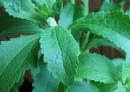
I have written about how wonderful Stevia is as an alternative to sugar. It’s a natural herb said to be 10 to 15 times sweeter than table sugar and it won’t negatively impact blood sugar levels. For those with a sweet tooth especially, I think it’s great.
I recently received this question, though: I have heard various things about staying away from stevia while trying to conceive. Have you? What do you think?
Here’s my answer: Yes, I have caught wind of some controversy over stevia and fertility and have looked into it before. The study that some refer to regarding negative fertility is one in which extremely large amounts of stevia (something like 5 or 6% of their body weight) was given to both male and female rodents, which subsequently affected their fertility and led to fewer and smaller offspring. A couple of things to say about this: no one would consume such a huge amount, esp. given that it is 10 to 15 times sweeter than table sugar. (For a 120-pound person, that’s about 7 pounds of stevia/day). If we consumed that amount of regular table sugar per day it too would negatively affect our fertility, and health – dramatically. So the study can be taken out of context. Also, numerous other studies followed (including another one on hamsters also with high doses of stevia) and found this not to be true at all, and found stevia to be safe. Not only that, but it’s a natural herb that amazingly does not affect blood sugar levels, which makes it esp. great for those suffering from diabetes—and a great alternative to regular sugar.
I think where stevia can have potential problems is when it gets packaged as a sweetener. I advise in our book (on pg. 12) that when you purchase stevia, be sure to read the label and make sure it’s pure. Some packaged forms add maltodextrin (sugar) and silica (you can Google that) – and although it’s in small amounts, it’s better not to have those forms with additives. Get it pure and use in small amounts, as it was intended.
I speculate that part of the reason the FDA in the US resisted approving stevia for a long time, and perhaps why the EU has banned its use for now, is that if allowed to be used in products as a sweetener, such as to sweeten soft drinks and a wide array of food products, in-take across a population would increase a lot, and they may feel they need more information before allowing that. There is also the political side (sadly). Artificial sweeteners have a lot of money and lobbying power (in US) and although these chemical sweeteners have been proven time and again to have ill effects on our health, the FDA has approved them.
I feel stevia is completely safe and a great alternative to sugar in the normal amounts with which we would consume them. Finally, something I found on the Internet from the Laboratory of Functional Biology, KULeuven:
“In 2004 researchers of the KULeuven (Belgium) organized an international symposium on “The Safety of stevioside”. Scientists from all over the world concluded that stevioside is safe, and that stevioside has not any effect on male or female fertility, nor on development and state of fetuses.” More info: http://bio.kuleuven.be/biofys/Plantfys_e.htm
Hope this answers your question!


ARCHIVED COMMENTS for this post:
Jun. 4, 2012 from Unknown:
About 8 years ago, I attempted the “Fat Flush Diet” which requires that the only sweetener you consume is stevia. Whole Foods was the only place I could find it then and there were blatant warnings on the box and each packet about the effect on fertility. All of a sudden, stevia is trendy and mainstream with not a single warning printed on the products. Just find it odd in this age of the big business food industry…
Jun. 5, 2026 from Cindy (Author):
Hi, there. Thanks for sharing your comment! I am not aware of stevia having such a warning label in the past, and I started using stevia here and there about 10 years ago. If it did, it may have been based on the study I reference in this blog post, which as you see from the blog post, has been taken completely out of context; and furthermore, subsequent studies have proven stevia to be safe with no ill effects on fertility.